
CORStest
A simple CORS misconfiguration scanner
Based on the research of James Kettle
CORStest is a quick & dirty Python 2 tool to find Cross-Origin Resource Sharing (CORS) misconfigurations. It takes a text file as input which may contain a list of domain names or URLs. Currently, the following potential vulnerabilities are detected by sending a certain Origin request header and checking for the Access-Control-Allow-Origin response header:
- Developer backdoor: Insecure dev origins like JSFiddle or CodePen are allowed to access this resource
- Origin reflection: The origin is simply echoed in ACAO header, any site is allowed to access this resource
- Null misconfiguration: Any site is allowed to access by forcing the
nullorigin via a sandboxed iframe - Pre-domain wildcard: notdomain.com is allowed access, which can simply be registered by an attacker
- Post-domain wildcard: domain.com.evil.com is allowed access, which can be registered by an attacker
- Subdomains allowed: sub.domain.com allowed access, exploitable if attacker finds XSS in any subdomain
- Non-ssl sites allowed: A http origin is allowed access to a https resource, allows MitM to break encryption
- Invalid CORS header: Wrong use of wildcard or multiple origins, not a security problem but should be fixed
Note that these vulnerabilities/misconfigurations are dependend on the context. In most scenarios, they can only be exploited by an attacker if the Access-Control-Allow-Credentials header is present (see -q flag).
Usage
usage: corstest.py [arguments] infile

positional arguments:
  infile         File with domain or URL list

optional arguments:
  -h, --help     show this help message and exit
  -c name=value  Send cookie with all requests
  -p processes   multiprocessing (default: 32)
  -s             always force ssl/tls requests
  -q             quiet, allow-credentials only
  -v             produce a more verbose output
Example
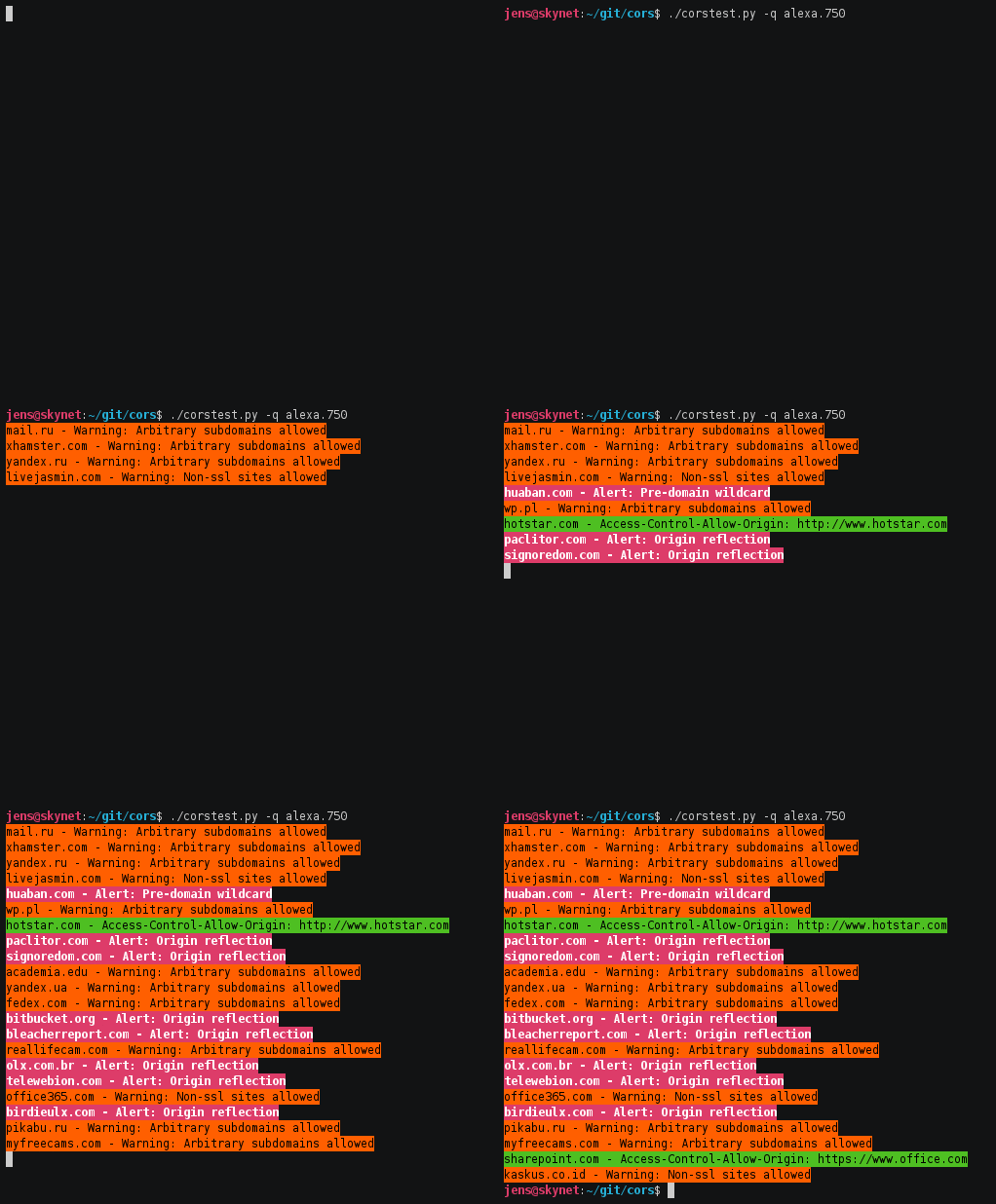
Use of CORStest to detect misconfigurations for the Alexa top 750 sites (with Access-Control-Allow-Credentials):
Evaluation
Running this CORStest on the Alexa top 1 million sites reveals the following results:
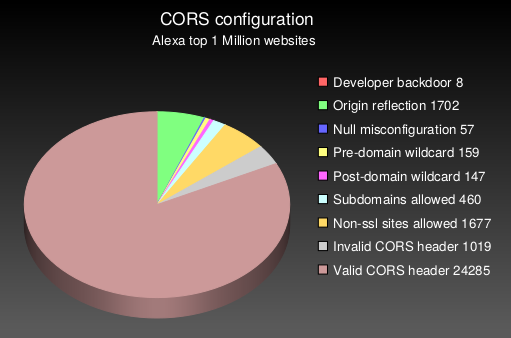
Note that the absolute numbers are quite low, because only 3% of the 1,000,000 tested websites had CORS enabled on their main page and could be analyzed for misconfigurations. This test took about 14 hours on a decent line (DSL). If you have a fast Internet connection, try to increase the number of parallel processes to -p50 or more.
Background
Read more on the technical backgorund of CORS misconfigurations in this fine blogpost or check out this talk. A large scale evaluation of CORS misconfigurations using CORStest is documented here.